
7 Best Gear Robotic Shot Peening Systems to Buy
Selecting a Gear Robotic Shot Peening System is not just a matter of comparing robot reach or advertised cycle times. Gear teeth have narrow roots, changing angles, and surfaces that can be shadowed by fixtures. The system must deliver repeatable coverage while controlling media flow, nozzle distance, and impact intensity. Small setup errors matter.
The International Federation of Robotics’ World Robotics 2024 report recorded 541,302 industrial robot installations worldwide in 2023. That figure provides context for growing industrial automation, but it does not measure shot-peening adoption or prove that automation alone improves part quality. For process requirements, buyers can consult relevant SAE aerospace shot-peening specifications, including AMS2430 and AMS2432, and verify which requirements apply to their gears and industry. Ask suppliers for documented trials on representative parts, not only polished demonstrations.
A strong buying comparison should examine more than the robot itself. Check the blast cabinet, media recovery and classification, controls, inspection records, guarding, maintenance access, and integration support. Request evidence of coverage and process consistency across tooth roots and flanks. Look closely at changeover time, too. It can quietly shape production costs.
This guide compares seven systems through those practical criteria, including likely strengths and trade-offs. No single cell suits every factory. A compact unit may fit limited floor space, while a larger automated line may handle higher volumes. The right choice depends on your gear geometry, quality requirements, throughput, and available support. Verify every claim against a trial and written specifications; brochures are not process evidence.
How Robotic Shot Peening Improves Gear Performance
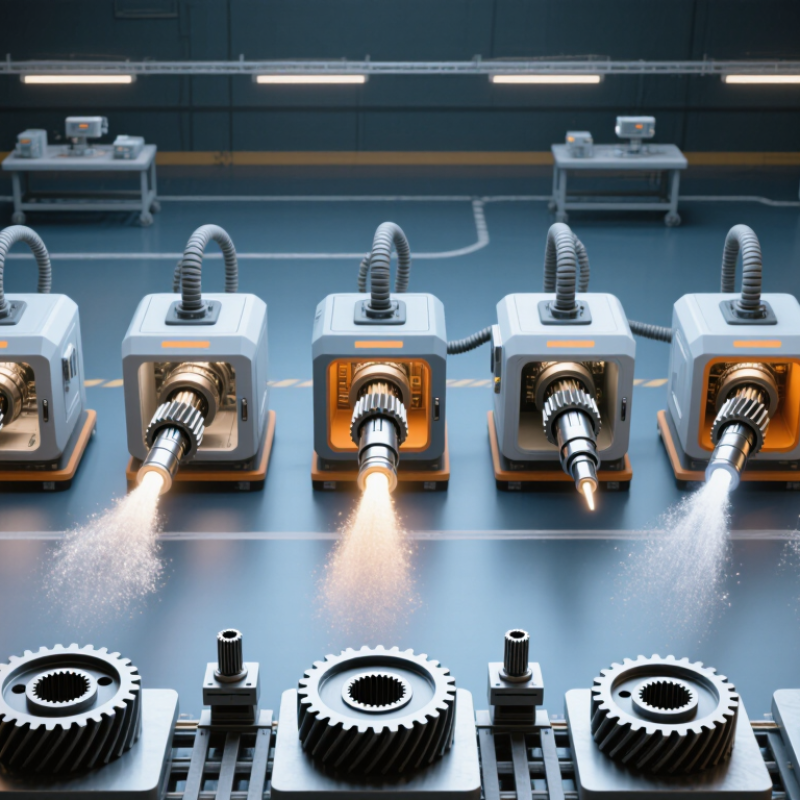
Robotic shot peening can improve gear fatigue performance by introducing compressive residual stresses near the surface. These stresses help resist cracks caused by repeated tooth loading, especially around the tooth root, where stress often concentrates. A robot can follow repeatable paths and maintain a controlled nozzle angle, distance, and travel speed. That consistency matters. Even small variations can leave uneven coverage on a complex gear.
The process still needs careful setup. Gear geometry, material, shot condition, and peening intensity all influence the result. Excessive treatment may roughen a tooth flank, affect contact behavior, or create unwanted variation. That is not magic. Engineers typically qualify the process with suitable intensity checks, coverage inspection, and part-specific testing. They should also confirm that the finished gear meets its dimensional and surface requirements. Automation reduces some operator-to-operator variation, but it does not replace sound process control. A poorly calibrated robot can repeat the same mistake very reliably.
7 Best Gear Robotic Shot Peening Systems to Buy - How Robotic Shot Peening Improves Gear Performance
Comparison of common system configurations, not specific products. Suitability and achievable process results depend on gear geometry, material, media, intensity, coverage, and validated process settings. Confirm capacity and specifications with the equipment supplier.
| System Configuration | Best Suited For | Part Handling and Access | Typical Media and Delivery | Process Control Considerations | Potential Gear Performance Benefit | Main Selection Trade-Off |
|---|---|---|---|---|---|---|
| 1. Single-Robot Enclosed Cell | Mixed batches of accessible gears, including spur and helical gears. | A six-axis robot moves the nozzle around a stationary or indexed gear fixture. | Controlled steel shot or conditioned cut-wire media delivered through a blast nozzle. | Recipe control should define nozzle path, stand-off distance, traverse speed, media flow, and coverage checks. Validate intensity with Almen strips where applicable. | Properly controlled peening can introduce surface compressive residual stress, which can improve resistance to fatigue crack initiation and propagation. | Flexible for varied parts, but cycle time can be longer than dedicated multi-station equipment. |
| 2. Robot with Rotary Gear Positioner | Gears requiring treatment around the circumference, such as tooth flanks and roots. | A robot directs the nozzle while a rotary positioner turns the gear to present different surfaces. | Recirculated, screened peening media with controlled particle size and condition. | Coordinate robot motion with rotation; verify overlap and coverage at tooth roots, flanks, and other critical areas. | More consistent presentation can help achieve repeatable coverage across gear teeth and reduce untreated shadow areas. | Positioner capacity and fixture design limit the size, mass, and shape of parts that can be handled. |
| 3. Dual-Robot Cell | Large gears or parts with complex surfaces that require multiple nozzle angles. | Two robots can work on separate zones or approach the part from different directions; coordinated motion is required. | One or more independently controlled blast circuits, typically using specified steel shot or cut-wire media. | Robot paths must be synchronized to prevent interference and maintain consistent intensity, distance, and coverage. | Multiple approach angles can improve access to complex tooth geometry and help make treatment more uniform. | Greater reach and process flexibility come with higher integration, programming, and maintenance demands. |
| 4. Gantry-Mounted Robotic System | Large-diameter gears, heavy components, and long or awkward workpieces. | A robot or blast head travels on a linear gantry, expanding the working envelope around a fixed part. | Enclosed blast delivery with media recovery, separation, and dust collection matched to the process. | Long travel paths require controlled acceleration, nozzle distance, and media flow; validate coverage throughout the work envelope. | Can provide repeatable access to broad surfaces and large gear profiles without repeatedly repositioning heavy parts. | Requires more floor space and careful management of gantry alignment and enclosure design. |
| 5. Multi-Station Indexing Cell | Production runs of similar gears with defined loading and unloading requirements. | An indexing table moves fixtures between loading, peening, and inspection or unloading positions. | Automated media circulation with screening and monitoring to maintain media condition. | Use locked recipes and routine checks for media size, intensity, coverage, and fixture repeatability. | Repeatable fixturing and automated sequencing can support consistent treatment from part to part. | Higher throughput is possible, but changeovers and part variation may reduce flexibility. |
| 6. Flexible Cell with Quick-Change Fixtures | Job shops or manufacturers processing multiple gear families in smaller batches. | Interchangeable fixtures and programmed robot paths accommodate different gear sizes and orientations. | Media selection and operating parameters are set for the gear material and approved process specification. | Each part family needs a validated recipe; fixture identification and program control help prevent setup errors. | Repeatable setups can support controlled peening across a range of gears while preserving process traceability. | Versatility reduces the need for dedicated equipment, but frequent changeovers require disciplined setup procedures. |
| 7. Automated Production-Line Cell | High-volume gear manufacturing with stable part designs and defined cycle-time targets. | Conveyors, robotic loading, or automated transfer integrate the peening cell with upstream and downstream operations. | Closed-loop media handling with separation, dust extraction, and routine media condition monitoring. | Production monitoring should track recipe status, part identification, media condition, intensity checks, and coverage verification. | Automation can improve process repeatability and support consistent fatigue-related surface treatment when the process is properly validated. | Best suited to stable production; line integration and changeovers can be costly and complex. |
FAQS
Look for repeatable coverage, suitable robot reach, and enough wrist load for your fixtures. Fast cycles alone prove little.
Request trials with parts shaped like yours. Inspect tooth roots, recesses, and narrow edges; flat test coupons may miss hidden gaps.
Check media flow, nozzle speed, and exposure time. Sensors should flag interruptions, while recipes record key settings. Small details matter.
Articulated cells offer flexible access; gantry systems handle large parts. Rotary tables support repeatable loading, while twin stations can process jobs in parallel.
Use representative parts during supplier trials. Check fixture size, nozzle access, and changeover time. A large work area can still be awkward.
Estimate media use, compressed air, filters, inspection labor, and planned downtime. Ask operators to test loading and recovery steps; spreadsheets miss things.
Record intensity checks, media condition, and part orientation. Inspect sample parts and recalibrate when fixtures or gear features change. Paths can drift in effect.
Ask how dust collection, media separation, and repairs work. Also ask what happens after a sensor check fails. The answer can be revealing.
Conclusion
This guide explains how robotic shot peening can improve gear performance by helping strengthen surfaces and support durability under demanding operating conditions. It outlines the key factors to assess before purchasing a Gear Robotic Shot Peening System, including process control, repeatability, workpiece handling, equipment flexibility, and compatibility with different gear sizes and production needs. The guide also introduces seven types of systems to consider, focusing on their general capabilities rather than specific manufacturers.
To compare options effectively, manufacturers should evaluate processing capacity, automation level, expected operating costs, and how well each system fits into existing workflows. The guide also highlights practical considerations for installation, operator safety, routine maintenance, and long-term reliability. By weighing these points together, buyers can identify a solution that meets their production requirements while supporting consistent treatment quality and manageable operating demands.
